
Scott Newell, Newell Recycling Equipment
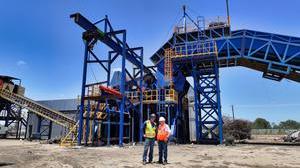
Scott Newell (r) with Plant Manager Justin Headrick (l) of customer Texas Auto Salvage
I have been making “world best practice” shredding plant presentations for more than 25 years, and each year someone raises their hand and asks, “Scott, you have been telling us of the improvements that have been made this year, but what do you expect will happen next year?” I almost always have responded that I don’t know what might happen, but during the next year I have almost always made another presentation with new evolutionary improvements!
It has given me a lot of good memories to spend some time thinking about the last 25 years and to recognize that our industry has made some very significant improvements in output production tons per hour for the same size main motor, greatly increased wear life for the replacement parts and greater amounts of uptime productive hours as a percentage of all hours available.
Newell used to rate our shredders by a rule of thumb that said we can produce 2 tons per hour of output shredded steel to a density of 1.0 (62.5 pounds per cubic foot) for every 100 HP on the main motor. Please note that these production numbers are not for the input of material into the shredder but rather for the output of shredded steel produced. The nonmagnetic fraction is separate.
We went from that 2 tons per hour output shredded steel to today’s production rates, where we rate our shredders at 2.5 or 3 tons per hour for the output shredded steel at a density of 1.1 to 1.2, for every 100 HP of the main motor and we know that the actual output can be up to 4 tons per 100 HP per hour. For example, we rate our typical 4000 HP shredder at 100 tons per hour of output shredded steel at a density of 1.2 and our 10,000 HP shredder is guaranteed to produce 400 tons per hour of output shredded steel. When we make density of 1.5 or 1.6 the tons per hour are reduced but the quality of the shredded steel goes up and earns a premium from the consumers of shredded steel.
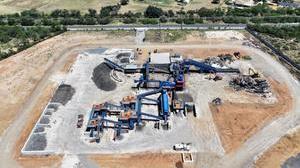
This plant is Newell's latest designed and installed complete system for Fe and Non-Fe recovery.
Today’s shredding plants are producing more output tons per hour, at lower costs per ton and very importantly, we are making much higher quality shredded steel, and we are recovering significantly higher values from the non-magnetic fraction of the product.
The most significant single improvement to shredding plants has been the application of computer technology. This has helped in two distinct ways. First, computer programs now control many of the operating decisions that must be made many times per second.
Computer programs measure and adjust, for example, when the main motor is being underutilized as indicated by the thermal capacity showing low percentage of use of the power available, and the measurement of amperage being utilized by the motor. Full Load Amps, FLA is the designed full load for the motor, and the motor is designed to dissipate the heat generated when the motor is operating at FLA. If the motor is being used at less than FLA, the thermal capacity reports the percentage of usage. Many shredding plants operate at very low percentages of what is available. If the operator has a thermal capacity gauge and actually looks at it, it is difficult to not want to find out how to improve the use of the available capacity.
When the computer program, such as the Newell Smart Shredding System (SSS) measures the usage and finds that it is being underutilized, the computer tells the feeding system to feed more material into the shredder. The feed rollers in a modern plant have variable speed hydraulic motors powering them. The infeed conveyor is also driven with variable speed hydraulic motor.
The function of air systems is controlled and varied by computer programs. When a metal loss sensor reports that an excessive number of metal pieces are reporting to the waste line, the computer is able to vary the velocity of the air separating system. There are a number of areas where the computer is able to modify the actual operating parameters in real time.
Secondly, computer programs report management data in great detail. The Newell philosophy is that “what gets measured, gets improved”. For example, the computer measures and reports, up time and down time and the causes for the down time. The tons per hour and the power consumed per ton of production are reported. There are trend lines for heat generated by bearings. The life of wear parts is predicted and then compared to the actual life. In the latest versions of the SSS, there are about 38 screens behind the dashboard screen, which are reporting data. When something does not measure up to expectations, it is normal that that issue be addressed.
In addition to the shredder being smarter through the computer operations and reporting systems, today’s shredder plants are tougher and stronger. The long evolutionary process of correcting mistakes and failures has taught us that some repair parts need to be thicker in some areas so that the part wears out uniformly. In the past, sometimes one end of a casting would wear out while the other end still had 50% life. This was improved by making the wearing end of the casting thicker so that the tendency for the part is to wear out evenly.
This happened with bottom grates, for example. The first 3 bars would wear out while the remaining bars still had 40% of life left. This led to the improvement of making the webs a bit thicker in the first grate bars so that the grate bar set now has a uniform life expectancy.
Another change to the bottom grates is the use of slotted grate holes, use of more holes of smaller size at the same time as creating about 30% more open area. This increases production tons per hour at any given density. It also practically eliminates “pokers” which can cause stop ups and damage to the conveyor systems.
Modern shredding plants are able to economically produce much higher density shredded steel. The higher density makes separations much more effective and as a result, it is possible to create a shredded product with lower copper residuals, while at the same time realizing the value of the separated copper. This is a win – win as both products have added value.
Much better design for castings such as pin held thick castings in the roof allow for better use of the weight of the wearing part, less failures and much reduced maintenance time to change and replace.
Modern shredders also have a back wall grate which last much longer than the previous solid back wall and it allows for some additional grate open space for material to leave the shredder.
Over time we have learned how to make better magnetic separations. Single layer burden depth with discrete particles makes a much better separation of magnetic pieces from the mixed shredded material coming from the shredder. When a thick burden depth of material is presented to a magnet, it is very normal to create what we call a “dirt sandwich” where waste material is trapped between pieces of magnetic material.
Air separation systems have been greatly improved in terms of effective separations and also completely closed loop air systems are now being used so that there is no discharge of air to atmosphere. This eliminates the possibility of emissions and the regulations that go with any type of actual air discharge to atmosphere.
Eddy current separation (ECS) systems have been greatly improved by identifying the proper belt speeds and the proper placement of the gates that create the separations. ECS systems also now come with different frequency separations which allows more effective separation of different materials.
Extensive use of induction sensing identification of metals and very much improved air blast tube separations have allowed much better separation and much reduced loss of material going the wrong way and reduces the metal being lost to the waste stream.
There have been very significant new improvements to sensor sorting by identification of different metals and different alloys of metals with LIBS, XRF and XRT identification of very specific alloys of metals. The identification followed by more effective air blast separations has created several new products that are being produced at modern shredding plants. If a specific alloy of aluminum is produced, that batch of material can be melted and made directly into a finished product. This is much more efficient than melting all recycled aluminum and then checking the alloy and then having to add and dilute to get to an alloy that can be used to make a product.
These evolutionary improvements have reduced the number of man hours per ton required, reduced the number of kWH of electricity per ton required, reduced the cost for wear parts significantly and at the same time increased the quality and value of the shredded steel and the quantity, quality and value of the nonferrous metals which are recovered.
Very often when making presentations like this, I often report that over my 65 years in the industry, I have learned a lot of things….. to not do! I have learned some things to do, but a lot of things to not do. This is the truth about evolutionary improvements. We try a lot of new things and some of them work, and we discard those that don’t work and go forward with what does provide for improvement. This industry has come a long way during my lifetime, and I am continuing to be optimistic that we will continue to make improvements for a long time into the future.