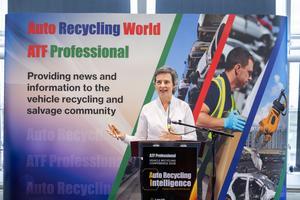
On Thursday 11 June, ATF Professional held its 2026 Conference at the British Motor Museum.
As you would expect with a conference focused on ATFs, sessions covered topics including the growing role of AI in dismantling vehicles, the challenges around EV batteries, current market conditions within vehicle recycling, and a deep dive into Toyota Europe’s vehicle recycling facility in Burnaston.
Crucially for BMRA members, Mary Creagh, Member of Parliament for Coventry East, delivered a 25-minute presentation. Officially, Mary is the Parliamentary Under-Secretary of State for Nature. In layman’s terms, she is the Government minister responsible for the circular economy. That makes meeting with her and understanding her views critically important to the BMRA.
The Minister began her talk by detailing how critical ‘scrap metals’ are to the competitiveness of the UK and its manufacturing base. She noted that the UK Government has recently established its Metals Circularity Group which, in the Government’s words, aims to ensure a sustainable supply of high-quality scrap for the domestic steel sector, while also considering how a circular economy can support supply chains for steel, aluminium and critical minerals. BMRA will be a key presence in this group.
For those of you who process batteries, or who have experienced a fire caused by one, Minister Creagh also confirmed that the Government is reviewing Extended Producer Responsibility for batteries, with a consultation due to be released in the autumn. In particular, this is very likely to examine the consistency of Best Available Techniques with the EU.
However, perhaps most concerning was several comments Minister Creagh made regarding exports. In particular, she stated: ‘we throw away our own future when we export [metals]’ and spoke at length about how rogue operators export materials, depriving the UK of valuable resources and causing environmental harm. As a result, she confirmed the Government is taking action by reviewing green list waste shipments, including those for steel.
Put simply, this review could mean that current markets available for steel become considerably more limited under waste controls, meaning those markets may become more burdensome to export to, or would only be accessible under ‘end of waste’ protocols. It is important to stress, however, that no final decisions have been made, and are unlikely to be made in the immediate future.
We will now be writing to the Minister to request a meeting to discuss these issues in greater detail.