
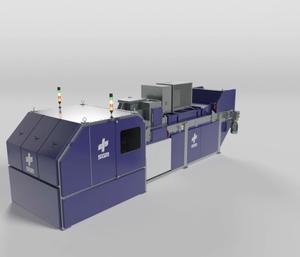
A breakthrough in advanced metal sorting technology has been formally recognised with the granting of a UK patent for the XRF‑T X-ray sorting system, a solution designed to transform the recovery and refinement of metals from mixed recycling streams.
The newly granted patent covers an “X-ray separator for sorting metals from recycled material”, incorporating innovative dual-technology integration to improve both accuracy and operational efficiency in metal recycling environments.
Solving persistent challenges in metal recycling
Metal recyclers have long faced a critical challenge: how to reliably separate complex, mixed materials, especially where light metals, heavy metals, and alloys are physically attached or chemically similar.
Traditional systems often rely on either:
- X-ray Transmission (XRT) for density-based separation, or
- X-ray Fluorescence (XRF) for surface composition analysis
However, each technology alone presents limitations in modern scrap streams. The XRF‑T addresses this gap by combining both approaches into a single integrated system.
A hybrid technology approach
The XRF‑T uniquely combines:
- XRF analysis to identify and sort heavy metals and alloys such as copper, zinc, brass, bronze, and stainless steels
- XRT analysis to detect density differences and identify internal composition, including aluminium contamination and composite pieces [XRF-T-EN | PDF]
This dual capability allows operators to:
- Detect and remove aluminium breakages attached to heavier metals
- Differentiate between stainless steel grades (e.g. 316 vs 304)
- Produce higher-value outputs from mixed streams
By processing both internal structure and surface chemistry simultaneously, the system delivers a level of sorting precision not achievable with standalone technologies.
Performance and commercial impact
The XRF‑T has been engineered for industrial deployment, offering:
- Material recovery rates exceeding 90%
- Purity levels above 98%
- Throughput of 2–4 tonnes per hour depending on application
Crucially, the integrated design allows operators, particularly small and medium-sized recycling facilities, to replace two machines (XRT and XRF) with a single unit, reducing:
- Capital expenditure
- Footprint requirements
- Maintenance complexity
Real-world application: Brass refining plant in Latvia
The benefits of advanced X-ray sorting are already being demonstrated in industrial settings. In a complete brass refining plant project in Latvia, advanced sorting technology has been deployed to improve feedstock quality and maximise recovery of valuable metals.
The facility processes complex scrap streams, where:
- Mixed non-ferrous materials must be refined into high-purity outputs
- Contaminants and alloy variations directly impact downstream melting efficiency
By using advanced X-ray-based sorting, operators can pre-clean and separate materials prior to smelting, reducing energy consumption, improving yield, and increasing the market value of final products.
Case study:
https://www.sgmmagnetics.com/en/complete-brass-refining-plant-in-latvia-metaleskpo-chooses-sgm/
Driving sustainability and circular economy outcomes
Accurate metal separation is a cornerstone of the circular economy. By improving purity and recovery rates, the XRF‑T supports:
- Reduced reliance on primary raw materials
- Lower CO₂ emissions in metal production
- More efficient use of existing scrap resources
Its ability to recover metals that would otherwise be lost or downgraded significantly enhances the economics of recycling operations.
Innovation backed by patent protection
The patent grant recognises the novelty of combining XRF and XRT technologies in a single system using a unified X-ray source and advanced processing software to deliver real-time sorting decisions.
The system also features:
- Self-learning software algorithms for continuous optimisation
- Remote connectivity for diagnostics and upgrades
- Robust industrial design for demanding recycling environments
Industry implications
With increasing pressure on recyclers to deliver higher purity outputs and improved traceability, the XRF‑T positions itself as a key enabling technology for:
- Non-ferrous scrap processors
- Automotive shredder residue (ASR) recovery
- Electronics and WEEE recycling
- Foundry-grade material preparation